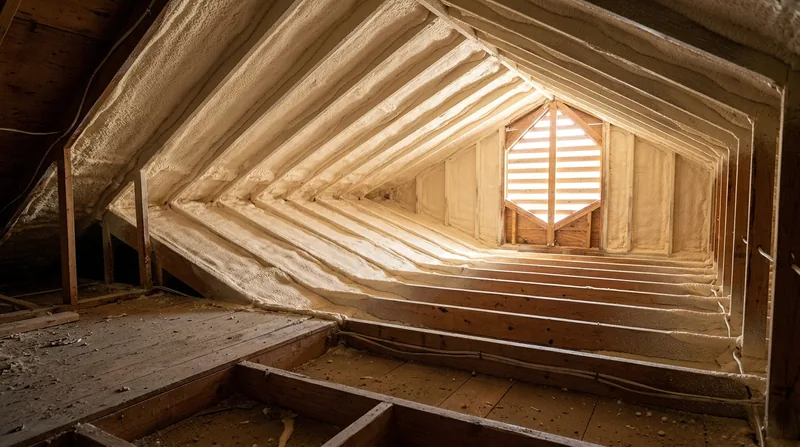




Springfield's attics experience dramatic seasonal swings, from summer heat that pushes 95°F into unconditioned spaces to winter ice storms that expose every thermal weak spot in your roof assembly. Most homes across Sangamon County, whether the older stock near downtown, the historic neighborhoods of Leland Grove, or the mid-century ranches scattered through Auburn and Williamsville, have attics with settled fiberglass, thin batts, or no insulation at all. That uncontrolled temperature swing drives your HVAC system hard and leaves ductwork exposed to both extremes. Attic spray foam insulation in Springfield seals the attic deck and rafters to stop that swing before it reaches your living space, protecting your equipment and cutting the load on your heating and cooling. We've been installing spray foam insulation across Greater Springfield since 2015, and we know the specific challenges that Sangamon County attics face. Let's walk through why this matters, how it works, and what to expect when you call.
Why Attic Spray Foam Insulation Matters in Springfield's Climate
Springfield winters bring ice storms that load your roof with weight and cold that penetrates any gap in your attic seal. Summers turn your attic into a convection oven that radiates down through the ceiling into your living space, forcing your air conditioning to run longer and harder. Spray foam stops both problems at the source: it seals air leaks that fiberglass never touches, and it creates a continuous thermal barrier that keeps the temperature swing from reaching your ductwork, insulation, and the rooms below.
- Sealed attics prevent ice dams by keeping the roof deck uniformly cold in winter, eliminating the warm spots that melt snow and refreeze at the eaves.
- Foam stops humid summer air from condensing on cold ductwork and metal fasteners, protecting equipment from corrosion and mold risk.
- A continuous air barrier reduces the workload on your HVAC system by preventing conditioned air from escaping through the attic.
- Spray foam holds its R-value over time, unlike fiberglass batts that settle and lose effectiveness within a few years.
These are the real failure modes in Springfield attics, and spray foam addresses every one of them.
Key info: The Illinois Building Code and Springfield's building department govern attic ventilation and thermal barrier requirements for spray foam. We help you navigate what applies at your address, and any permit requirements are handled as part of the scope. Check with your local building official or call us at (217) 441-9079 to confirm what's required for your home.
For more detail on how closed cell and open cell foam compare, see our closed cell spray foam insulation page, which covers the technical differences and typical attic applications.
How We Spray Foam Your Attic: The Process in Springfield
Spray foam insulation starts with a site visit to measure your attic, identify air leaks, assess existing insulation, and check for moisture, roof leaks, or other conditions that must be addressed first. We then provide a written estimate that specifies the R-value, foam thickness in inches, and the coverage area so you know exactly what you're paying for. On the job day, we set up mechanical ventilation to manage vapors during application, apply the foam in controlled passes to the specified thickness, and allow the proper cure time before re-entry, which is typically twenty-four to forty-eight hours depending on conditions.
- We schedule a free estimate visit to measure your attic, review existing insulation, and discuss R-value and thickness options for your climate.
- Our written estimate includes the R-value target, foam thickness in inches, square footage, and a breakdown of labor and materials so there are no surprises.
- We set up mechanical ventilation and temporary containment during spray to manage off-gassing and keep odors from entering living spaces.
- Foam is applied in multiple passes to the thickness specified in the estimate, allowing proper rise and density for long-term performance.
- We document cure time and provide a re-entry window so you know when it's safe to occupy the home and when the foam has reached full strength.
The entire process is transparent, documented, and built around the specifics of your attic and Springfield's climate.
Local example: A 1,200 sq ft attic in Sherman with settled fiberglass and air leaks around the soffit typically takes one to two days to spray to R-38 closed cell, with a re-entry window of thirty-six hours. The homeowner can schedule HVAC work or other trades after that window closes and the foam is fully cured.
If your attic has old or failed insulation that must come out first, see our insulation removal page for details on how we handle that precondition work.
Attic Spray Foam Methods: Closed Cell vs. Open Cell
| Approach | Description | Best for |
|---|---|---|
| Closed Cell Spray Foam | High-density foam (3.5 to 3.6 lb/cu ft) that creates a vapor barrier and air seal in a single pass. R-value of 6.0 to 6.5 per inch. Rigid and durable once cured. | Sealed attics in Springfield where vapor control is critical, ice dam prevention is a priority, and the attic will not be vented. Also ideal for attics with moisture concerns or high humidity. |
| Open Cell Spray Foam | Lower-density foam (0.5 to 1.5 lb/cu ft) that allows vapor transmission. R-value of 3.5 to 3.8 per inch. Softer and more flexible, also offers sound dampening. | Vented attics where moisture must be allowed to pass through, or where you want a lower cost per R-value and sound insulation is a secondary benefit. |
| Top-Up with Open Cell | Adding open cell foam over existing fiberglass to reach a higher R-value without removing the old insulation if it is sound and in place. | Attics in Chatham, Leland Grove, or Rochester where existing insulation is still performing and you need to boost R-value for winter performance without full removal. |
| Removal and Spray | Complete removal of old or failed insulation, debris cleanup, and spray foam application to the deck or rafters at the specified thickness. | Attics with settled, compressed, or contaminated insulation, or where you need a clean slate and a sealed attic assembly from the start. |
The choice between closed cell and open cell depends on your attic design, climate goals, and whether the space will be vented or sealed. We'll review both options in your free estimate and recommend what makes sense for your home.
Attic Spray Foam Insulation Cost in Springfield: What to Expect
Attic spray foam insulation in Springfield typically starts at $1.50 per square foot for open cell applications and rises to $2.50 to $3.50 per square foot for closed cell, depending on the R-value, foam thickness, accessibility, and whether existing insulation must be removed first. A 1,200 sq ft attic to R-38 closed cell with removal runs roughly $3,000 to $4,200 before any permits or additional work. The exact price depends on the attic layout, how much old insulation is in place, whether ductwork or obstructions make access difficult, and the local building code requirements at your address.
Several factors move the price up or down. If your attic is easy to access with clear deck space, the cost per square foot stays lower. If the attic has a maze of ductwork, rafter ties, or trusses that force the crew to work around obstacles, labor time increases. Removing old insulation adds cost but is often necessary to ensure proper foam adhesion and to prevent moisture trapping. If your home is in an HOA or a historic district, additional compliance or documentation may apply, though insulation itself is rarely restricted.
We recommend getting two or three estimates from local contractors so you can compare R-value specs, thickness, labor, and removal costs side by side. The cheapest estimate is often a red flag: if it has no R-value or thickness written down, or if the price is far below market with no inspection offered, walk away. A fair estimate is transparent, specific, and includes a site visit.
For our full pricing breakdown and to see how other jobs in Springfield are structured, visit our pricing page. Call (217) 441-9079 to schedule your free estimate and get a firm number for your attic.
Attic Spray Foam Insulation Near Me: What Springfield Homeowners Should Know When Hiring a Contractor
When you're looking for a spray foam contractor near Springfield, start by verifying that the company is fully insured and can provide proof of coverage. Ask for references from recent jobs in your area, and contact those homeowners to ask about the quality of the work, whether the job stayed on schedule, and whether there were any issues after completion. Request a written estimate that includes the R-value, foam thickness in inches, square footage, the cost to remove old insulation if needed, and a timeline. If the estimate is vague, missing R-value specs, or far below other quotes with no explanation, that's a sign to look elsewhere.
- Verify the contractor is fully insured and ask to see a current certificate of insurance covering general liability and workers' compensation.
- Request written references from at least two jobs completed in the past year in Springfield, Chatham, or nearby towns, and actually call them.
- Confirm that your local building department's permit requirements are understood and will be handled as part of the job scope.
- Get a detailed written estimate that specifies R-value, foam thickness in inches, coverage area, removal costs if applicable, and the timeline from start to re-entry.
- Ask about the contractor's re-entry window and cure time, and confirm that mechanical ventilation will be used during application to manage vapors.
A professional spray foam contractor will answer these questions without hesitation and will never rush you into a contract or promise results that sound too good to be true.
If you're ready to move forward, contact us for a free estimate, or call (217) 441-9079. We serve Springfield, Chatham, Sherman, Rochester, and the wider Sangamon County area, and we're available for estimates within twenty-four hours.
Attic Spray Foam Insulation in Springfield: Pricing Guide
| Service | Price | Details |
|---|---|---|
| Open Cell Spray Foam Attic | Starting at $1.50/sq ft | Vented attic application over existing insulation or to bare deck, includes labor and material for R-28 to R-35 |
| Closed Cell Spray Foam Attic | Starting at $2.50/sq ft | Sealed attic with vapor barrier, R-38 to R-49, labor and material, includes mechanical ventilation during cure |
| Removal and Spray Combination | Starting at $2.75/sq ft | Old insulation removal, debris haul, and closed or open cell foam application, price varies by removal volume and attic access |
| Complex or Large-Scale Job | On estimate | Multi-story homes, extensive ductwork, difficult access, or mixed foam types require on-site measurement and scope review |
| Travel | Included | No separate mileage fee for Springfield, Chatham, Sherman, Rochester, Riverton, and surrounding Sangamon County service areas |
| Free Estimate | Free | Response within twenty-four hours at (217) 441-9079, site visit includes R-value and thickness recommendations with no obligation |
Indicative pricing, the exact cost depends on square footage, finish, and site access. Free personalized estimate within 24h at (217) 441-9079.


