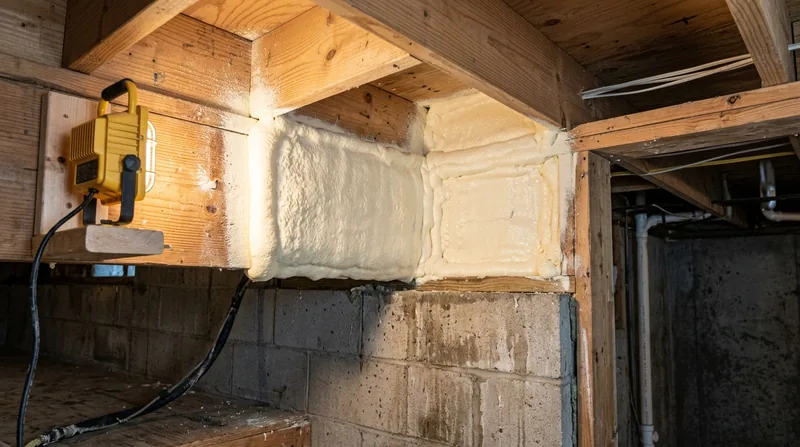




Closed cell spray foam insulation in Springfield solves the moisture and thermal problems that plague older homes near downtown and the capitol, as well as the mid-century ranches and newer subdivisions scattered across Sangamon County. Springfield's basements and crawl spaces stay cold in winter and often turn damp after rain, while attics swing from scorching in summer to frigid in winter, driving energy bills and creating conditions where settled fiberglass fails to seal air leaks. Closed cell foam adds rigidity to rim joists and foundation walls, resists the moisture that collects after storms, and creates an airtight thermal boundary that fiberglass alone cannot match. Whether your home sits in the historic neighborhoods of Leland Grove, the ranch-lined streets of mid-Springfield, or the newer construction pushing toward Chatham and Sherman, closed cell foam addresses the real failure modes of Midwest construction. We have served Springfield and Sangamon County since 2015, and we spray foam to specification, not to a timeline. Learn more about our full range of spray foam and air sealing services.
Why Closed Cell Spray Foam Matters in Springfield's Older Homes and Basements
Springfield's housing stock tells the story of why closed cell foam works here. The homes clustered near downtown and the state capitol often have open wall cavities that were never fully insulated, and their basements sit under the water table for much of the year. Rim joists, the band of wood that sits on top of the foundation wall and holds up the first floor, are the coldest, wettest parts of these houses. Rain soaks into the soil around the foundation, moisture wicks up through the concrete and into the rim joist cavity, and fiberglass or cellulose absorbs it like a sponge, losing its R-value and rotting the wood. Closed cell foam stops that moisture dead and keeps the rim joist dry and rigid. The same logic applies to crawl spaces across the county, where standing water or high humidity after storms ruins blown-in insulation within months.
- Closed cell foam resists water absorption and maintains its R-value even when the substrate is damp or has been damp in the past.
- The rigid structure of closed cell foam adds bracing strength to rim joists and band joists, reducing flex and noise.
- Closed cell foam creates a continuous air seal, stopping the cold air infiltration that fiberglass batts and blown-in insulation allow around pipes, wires, and framing.
- Closed cell foam cures to a hard shell that does not settle, slump, or shift over decades the way loose-fill insulation does.
These properties make closed cell foam the right answer for Springfield's basements, crawl spaces, and rim joists, and the reason we recommend it over open cell foam or fiberglass for below-grade and high-moisture applications.
Key info: Springfield's Sangamon River basin and proximity to Lake Springfield mean that Sangamon County homes experience significant seasonal vapor drive. In humid summers, moisture pushes inward through walls and attics. In dry winters, it reverses. Closed cell foam's vapor impermeability makes it the correct choice for rim joists and basement walls, where inward drive during summer would otherwise saturate fiberglass and cause wood rot. For more on the science of air sealing and moisture control, see our air sealing page.
For regulatory guidance specific to your address in Springfield, Chatham, Sherman, or another Sangamon County community, contact your local building department. Illinois 811 requires utility locates before any excavation, though spray foam insulation work rarely involves digging. Thermal and ignition barriers are mandated by code and are installed as part of the job.
How We Spray Closed Cell Foam: The Springfield Process
Closed cell foam is sprayed as a liquid, expands as it cures, and hardens into a solid block. The process requires precision: the foam must be applied in the correct thickness per pass (typically 1 to 2 inches per application), the equipment must maintain the manufacturer's resin-to-hardener ratio and drum temperature, and the space must be mechanically ventilated during cure to manage off-gassing. A homeowner or occupant must stay out of the treated area for 24 to 48 hours after the spray is complete. Rushing that window or skipping ventilation is how spray foam jobs go wrong, and it is the single biggest marker of a contractor cutting corners.
Our process begins with a site visit and written estimate that names the R-value, the thickness in inches, and the board-foot total. We identify the substrate condition, moisture history, and any existing insulation or debris that must be removed. We then schedule the spray on a day when the space can be sealed off and ventilation equipment can run uninterrupted. During the spray, we apply the foam in passes, allow partial cure between applications, and reach the specified thickness and R-value. After cure, we verify the installation against the estimate and schedule the re-entry window in writing.
- We assess the rim joist, crawl space, or basement wall in person and document moisture, existing insulation, and access before quoting.
- We provide a written estimate that specifies R-value, thickness, and board-foot total, never a vague price range.
- We spray closed cell foam in controlled passes, maintain equipment temperature and ratio per the manufacturer, and do not rush the cure.
- We run mechanical ventilation during cure and provide a written re-entry window of 24 to 48 hours before the space is safe to occupy.
- We walk away from any substrate that is wet, actively leaking, or contaminated, because foam cannot fix moisture problems, only seal them once they are resolved.
This discipline is what separates a lasting installation from a problem that surfaces months later when the smell will not go away or the foam has not cured properly.
Example: A 1960s ranch home in Chatham with a damp basement and a failing fiberglass rim joist insulation. We remove the old fiberglass, let the rim joist dry, spray 2 inches of closed cell foam to R-13, and seal all rim joist seams and band joist penetrations. The homeowner stays out for 48 hours while ventilation runs. The result is a rigid, moisture-resistant thermal break that will not settle or absorb water for decades. Learn more about rim joist and band joist foam applications.
Closed Cell Spray Foam Insulation Methods and Applications
| Application | Description | Best for |
|---|---|---|
| Rim and Band Joist Foam | Closed cell foam sprayed directly onto the rim joist and band board, typically 1 to 2 inches thick, creating a rigid thermal and air barrier at the foundation line. | Damp basements, cold first floors, and moisture-prone foundation walls in Springfield's older homes and mid-century ranches. |
| Crawl Space Insulation | Closed cell foam applied to crawl space walls and band joists, often as part of a larger moisture control strategy. Foam does not encapsulate standing water or replace sump pumps. | Sangamon County crawl spaces with seasonal moisture, high humidity, or previous fiberglass failure. |
| Wall and Injection Foam | Closed cell foam injected into existing wall cavities of pre-1980 homes through small drilled holes, without removing drywall or siding. | Historic Springfield homes near downtown and Leland Grove with open or settled insulation and no budget for demolition. |
| Metal Building and Sealed Attic Decks | Closed cell foam sprayed to the underside of metal roof decks or sealed attic trusses, creating a rigid, moisture-resistant thermal envelope that prevents condensation on cold metal. | Barndominiums, pole barns, and metal buildings across Sangamon County where condensation and thermal bridging through steel is the primary failure mode. |
Closed Cell Spray Foam Insulation Cost in Springfield: What to Expect
Closed cell spray foam typically starts at $1.20 per board foot in Springfield and surrounding areas, though the final cost depends on several concrete factors. The size and complexity of the area being sprayed, the condition of the substrate, the R-value and thickness specified, and the accessibility of the rim joist or crawl space all move the price up or down from that baseline. A small rim joist job in a 1960s ranch in Chatham might run 200 to 400 board feet and land in the $240 to $480 range. A full crawl space in a larger home or a metal building retrofit can easily exceed 1,000 board feet and cost several thousand dollars. Removal and disposal of old insulation, if required, is an additional line item.
The best way to know what your job will cost is to request a free written estimate. We visit your home or building, measure the area, assess the substrate and moisture condition, and provide a quote that names the R-value, thickness, and total board feet. We do not charge for the estimate, and there is no obligation to book. Response time is within 24 hours at (217) 441-9079. For a detailed pricing overview and examples of common job scopes, see our pricing page.
Closed Cell Spray Foam Insulation Near Me: What Springfield Homeowners Should Know When Hiring
Choosing a spray foam contractor is not like hiring a tree service or a roofer. The work is chemical, the cure process is invisible, and a mistake does not show up until weeks later when the smell will not go away or the foam has failed to cure. The spray foam trade includes both local independents who have been in business for years and rig-and-run crews that arrive in an out-of-state trailer, spray a job in an afternoon, and vanish. The difference is in the details: how they estimate, how they manage the cure, and whether they are reachable if something goes wrong.
When you call a spray foam contractor, ask for a written estimate that names the R-value, thickness in inches, and total board feet. If they give you a price without those details, hang up. Ask whether they provide mechanical ventilation during cure and what the re-entry window is. If they promise immediate re-entry or no ventilation needed, that is a red flag. Verify that they are fully insured and ask for a certificate of insurance naming your address as the job site. Check references from similar jobs in Springfield or nearby towns, and call at least two. Ask your local building department in Springfield or your city whether the contractor is registered or has any complaints on file. Do not assume that cheaper is better. The lowest bid often comes from a crew that will cut corners on ventilation, ratio management, or thickness, and you will pay for it later.
- Request a written estimate that specifies R-value, thickness, and board-foot total before you commit to a date.
- Confirm that the contractor will provide mechanical ventilation during cure and will enforce a 24 to 48-hour re-entry window in writing.
- Verify that the contractor is fully insured and ask for proof of coverage before work begins.
- Call at least two references from similar jobs completed in the past year and ask about the quality of the work and the contractor's responsiveness after the job.
- Contact your local building department to confirm that the contractor is registered to work in your city and to ask whether any complaints have been filed.
A local contractor with years in Springfield, transparent estimates, and verifiable insurance is worth the phone call. Contact us for a free estimate and a conversation about your specific needs.
Closed Cell Spray Foam Insulation in Springfield: Pricing Guide
| Service | Price | Details |
|---|---|---|
| Rim Joist and Band Joist Foam | Starting at $1.20/board ft | Typical rim joist jobs run 150 to 500 board feet depending on home age, foundation size, and access to the joist. |
| Crawl Space Insulation | Starting at $1.20/board ft | Crawl space jobs range from 300 to 1,200 board feet based on foundation footprint, ceiling height, and moisture condition. |
| Wall and Injection Foam Retrofit | Starting at $1.20/board ft | Wall cavities in pre-1980 homes typically require 200 to 800 board feet per floor depending on wall area and cavity depth. |
| Metal Building or Sealed Attic Deck | Starting at $1.20/board ft | Metal building and sealed deck jobs often exceed 1,000 board feet and are quoted on-site due to roof pitch, span, and condensation risk. |
| Insulation Removal and Disposal | On estimate | Removal of old fiberglass, cellulose, or failed foam is quoted separately and depends on volume, contamination, and disposal access. |
| Free Written Estimate | No charge | Response within 24 hours at (217) 441-9079. Estimate includes R-value, thickness, board feet, and labor scope. |
Indicative pricing, the exact cost depends on square footage, finish, and site access. Free personalized estimate within 24h at (217) 441-9079.


