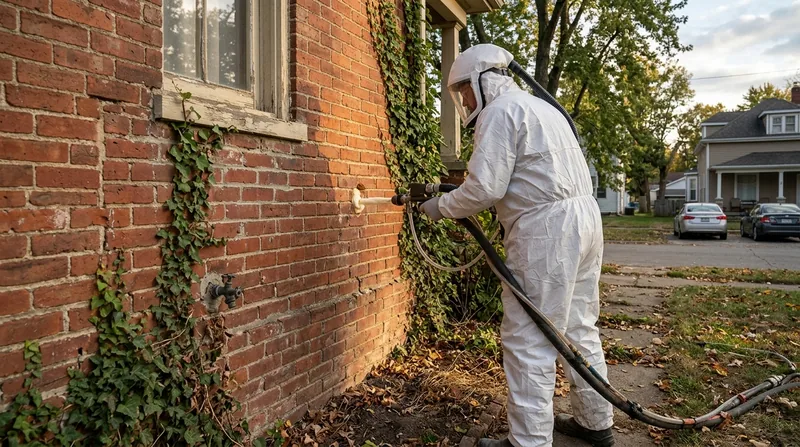




The historic homes clustered around downtown Springfield and the leafy neighborhoods of Leland Grove were built with solid plaster walls and brick cavities that hold decades of settling insulation, drafts, and cold spots that no amount of weatherstripping fixes. Newer ranches scattered across Sangamon County face the same problem: walls that were never insulated, or insulation that has compacted into useless dust. Wall and injection foam insulation fills those hidden cavities without tearing into plaster, siding, or drywall, restoring the thermal envelope and cutting the cold air that bleeds through exterior walls every winter. We drill small holes, pump in foam to the correct density and thickness, patch the holes to match the original finish, and leave no trace. The work is invisible, the results are immediate, and it costs far less than opening walls or replacing siding.
Why Wall and Injection Foam Insulation Matters in Springfield's Historic Housing Stock
Springfield's architectural character depends on homes built before modern building codes standardized wall insulation. The Victorian and Craftsman houses near the Capitol, the brick colonials around Leland Grove, and the mid-century ranches dotting the wider county were often built with exterior walls that contained only air, or with vermiculite or mineral wool that has settled to the rim joist, leaving the upper cavities empty. Winter cold radiates through these walls; summer heat follows the same path. A single exterior wall in a bedroom or kitchen can be ten to fifteen degrees colder than the room air, and no amount of thermostat adjustment fixes it because the problem is not the furnace, it is the envelope.
- Injection foam reaches cavity depths that blown-in insulation cannot, filling the full wall thickness without opening plaster or brick.
- The process takes hours, not days, and requires no drying time between coats or mechanical ventilation after the job is done.
- Holes are drilled on the interior or exterior depending on siding type and access, then patched with filler and paint matched to the original finish.
- The foam seals air leaks at the same time it insulates, stopping drafts that come through rim joists, band boards, and the gap between the wall cavity and the rim.
Homeowners in Springfield who choose injection foam typically see an immediate reduction in wall temperature variation and often notice quieter rooms because the foam also dampens exterior noise.
Key info: A 1,200 square foot house with two uninsulated exterior walls on the north and west sides might have 400 to 500 board feet of cavity space. At typical Springfield winter temperatures, that uninsulated wall assembly can cost $40 to $80 per month in lost heat. Injection foam pays for itself in two to four years through winter heating savings alone.
For guidance on what permits or inspections apply to your specific address in Springfield, contact the Springfield Building Department at the city hall office or visit the city website to confirm whether wall insulation work requires a permit in your zone. Air sealing around the foam installation is often the next logical step to close any remaining gaps in rim joists or band boards.
How Wall Injection Foam Installation Works in Springfield Homes
The process begins with a walk-through to identify which walls are uninsulated or under-insulated, to measure cavity depth and width, and to check for obstacles like plumbing, electrical wiring, or gas lines that must be avoided. We discuss whether holes will be drilled on the interior or exterior, and we agree on patch and paint finish before work begins. Most residential jobs in Springfield are completed in a single day.
- We locate the wall cavities using a stud finder and a small test hole, then drill injection ports at intervals along the wall height, typically every 16 to 24 inches vertically.
- Foam is mixed to the manufacturer's ratio and temperature spec, then pumped into each cavity at controlled pressure until the cavity is full and foam begins to back out of the port.
- Ports are sealed, holes are filled with matching putty or caulk, and the wall is painted or stained to blend with the surrounding surface.
- We verify R-value and foam thickness by core sample or measurement, and provide documentation showing the board feet installed and the cavity coverage achieved.
The entire sequence, from setup to final paint, takes four to eight hours depending on wall area and access. We do not re-enter the home or allow occupancy until twenty-four to forty-eight hours have passed to allow VOC off-gassing to complete.
Example: A 1920s brick colonial in Leland Grove with three exterior walls and plaster interior finish. We drilled ports through the plaster on the interior, injected closed-cell foam into the brick cavity (approximately 3.5 inches deep), sealed and patched the holes with matching plaster compound and paint. Total wall area: 850 square feet. Board feet: 320. Time to completion: 6 hours. The owner reported that the bedroom on the north wall was no longer cold to the touch in January, and the heating bill dropped approximately $35 per month.
If your walls also need attic spray foam insulation or rim joist and band joist foam, we can often bundle the work into a single mobilization and reduce the total cost.
Wall Injection Foam Methods and Approaches
| Approach | Description | Best for |
|---|---|---|
| Closed-cell injection foam | High-density foam (typically 2 to 3 pounds per cubic foot) that expands minimally and hardens to a rigid shell. R-value approximately 6 to 7 per inch. Used in cavities with limited depth or where vapor control is critical. | Exterior brick or stone walls, cavity depths under 4 inches, walls subject to wind-driven rain or humidity extremes. |
| Open-cell injection foam | Lower-density foam (typically 0.5 to 1 pound per cubic foot) that expands to fill the cavity and remains slightly flexible. R-value approximately 3.5 to 4 per inch. Allows vapor to move through the assembly. | Interior wall cavities in dry climates, sound dampening, cavities deeper than 4 inches where expansion is an advantage. |
| Partial-fill injection | Foam is pumped to a specified thickness (typically 2 to 3 inches) rather than to the full cavity depth, leaving an air gap or allowing room for future access if needed. | Historic homes where cavity depth is uncertain, or where the cost of full-fill exceeds the homeowner's budget. |
| Full-cavity injection | Foam is pumped until the entire cavity from exterior sheathing to interior finish is filled, maximizing R-value and air sealing. | New construction, major renovations, or retrofit projects where maximum thermal and acoustic performance is the goal. |
The choice between closed-cell and open-cell depends on the cavity depth, the climate control of the space, and whether vapor permeability matters to the wall assembly. In Springfield's cold winters and humid summers, closed-cell is typically the safer choice for exterior walls because it resists moisture ingress and does not require a separate vapor barrier.
Wall and Injection Foam Insulation Cost in Springfield: What to Expect
Wall injection foam typically costs starting at $2 per square foot of wall area, with the final price depending on cavity depth, wall length, accessibility, and the type of foam selected. A 500 square foot wall project in Springfield would start around $1,000 to $1,200 before permits or finishing touches. Closed-cell foam costs more per board foot than open-cell, but delivers higher R-value per inch and better vapor control, which justifies the premium in most Springfield applications.
Several factors move the price up from that baseline. Walls that are difficult to access, such as those behind built-in cabinets or furniture, require more drilling and take longer to complete. Cavity depths greater than 6 inches require more foam and more pump time. Exterior walls on brick or stone homes sometimes need specialized drilling techniques to avoid damaging the masonry. Interior finishes that are hard to patch, such as textured plaster or hand-troweled stucco, add labor to the finishing phase. If existing insulation or debris must be removed before foam is injected, that is an additional cost.
The most reliable way to know the true cost for your home is to request a free on-site estimate. We measure the wall area, probe the cavities, discuss your priorities, and provide a written quote with R-value, foam thickness, and board footage specified. We recommend getting two or three estimates from different contractors so you can compare methods, warranty terms, and pricing. The lowest bid is not always the best value; verify that the estimate includes a written thermal barrier and ignition barrier compliance statement, that mechanical ventilation during cure is specified, and that the re-entry window is clearly stated as twenty-four to forty-eight hours.
For a detailed pricing overview of all our services, visit our pricing page.
What to Look for When Hiring a Wall and Injection Foam Contractor Near Me in Springfield
Hiring a spray foam contractor is a significant decision because the work is hidden, the materials are specialized, and a poor installation can lead to odor complaints, inadequate insulation, or moisture problems that emerge months later. The difference between a professional installation and a quick job is often invisible to the eye, which is why credentials, process, and references matter more than price alone.
Start by verifying that any contractor you consider is fully insured and can provide a current certificate of insurance naming you as an additional insured. Ask for at least three references from homeowners in Springfield or nearby towns who had similar work done within the last two years, and contact those references to ask whether the contractor showed up on time, cleaned up afterward, and whether any odor or off-gassing issues occurred. Request a written estimate that specifies the R-value per inch, the total board feet to be installed, the foam type (closed-cell or open-cell), the thickness of each pass, and the re-entry window. Any estimate that omits these details, or that promises immediate re-entry or no smell, is a red flag.
Ask the contractor whether a permit is required at your specific address in Springfield. Permitting rules vary by zone and by the scope of work, so a contractor who says permits are never needed is either uninformed or cutting corners. Contact the Springfield Building Department to confirm what applies to your project, and work with a contractor who is willing to help you navigate the process. If your home is in a historic district or an HOA-governed community, ask whether architectural approval is needed before exterior drilling begins.
Verify that the contractor has handled wall injection work in homes similar to yours. A contractor who specializes in attic foam may not have the equipment or experience to inject cavities safely without damaging plaster, wiring, or plumbing. Ask how they locate utilities and plumbing before drilling, and whether they have insurance that covers accidental damage. Finally, confirm that the contractor will provide a written warranty on workmanship covering at least one year, and that they will stand behind the installation if problems arise.
Ready to get started? Contact us today for a free estimate, or call (217) 441-9079 to discuss your wall insulation project with a field professional who knows Springfield homes inside and out.
Wall & Injection Foam Insulation in Springfield: Pricing Guide
| Service | Price | Details |
|---|---|---|
| Wall injection foam, interior or exterior | Starting at $2/sq ft | Includes drilling, foam injection, patching, and paint blend. Price varies with cavity depth and wall accessibility. |
| Closed-cell foam injection | Starting at $2.50/sq ft | Higher R-value per inch, better vapor control, ideal for exterior walls and cavities under 4 inches deep. |
| Open-cell foam injection | Starting at $1.75/sq ft | Lower cost, good sound dampening, suitable for interior cavities and deeper wall assemblies where vapor permeability is acceptable. |
| Complex retrofit or historic plaster repair | On estimate | Specialized finishing, masonry drilling, or difficult access requires on-site assessment before pricing is confirmed. |
| Travel and mobilization | Included | No separate charge for service calls within Springfield and surrounding Sangamon County service area. |
| Free written estimate | No cost | Includes R-value, thickness, board footage, and compliance notes. Response within 24 hours at (217) 441-9079. |
Indicative pricing, the exact cost depends on square footage, finish, and site access. Free personalized estimate within 24h at (217) 441-9079.


