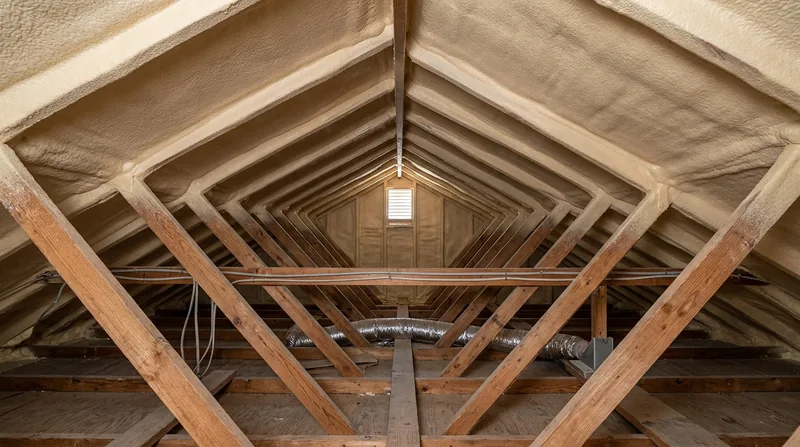




Springfield's housing stock tells the story of why insulation replacement and re-insulation matters here. The older homes clustered near downtown and the state capitol often carry open wall cavities and deteriorated batts from decades past. The mid-century ranches scattered across Sangamon County have attics where original fiberglass has settled flat, leaving ductwork and framing exposed to the cold winters and humid summers that define this region. Newer subdivisions pushing toward Chatham and Sherman bring two-story construction with rooms over garages, but even these homes develop thermal weak spots as insulation settles or moisture compromises its R-value. When existing insulation fails, the cold rim joists and basement walls that sit under most Springfield homes turn into energy drains, and the attics that should protect against summer heat become liabilities. We remove failed insulation and re-insulate with spray foam sized for the energy code that applies at your address and suited to the climate and framing of each home.
Why Insulation Replacement Matters in Springfield's Older and Mid-Century Homes
Springfield's housing stock was built in waves, and each wave brought different insulation standards and different failure modes. Homes built before 1980 often have open wall cavities or cellulose that has settled and lost its thermal resistance. Fiberglass batts in attics compress under their own weight over time, especially in the humid summers when moisture adds mass and gravity wins. Crawl spaces and rim joists under older homes in the Leland Grove historic district and around the outlying areas near Lake Springfield are chronically cold and damp, with insulation that never held up to the seasonal vapor drive that flips between humid summers and dry winters. When you replace failed insulation with spray foam, you gain air sealing at the same time, which stops the infiltration that fiberglass alone cannot address. The energy code in force at your Springfield address sets the R-value and thickness we must hit, and we write that into every estimate.
- Settled fiberglass in attics leaves ductwork and framing exposed to temperature swings and humidity that drive energy bills higher every year.
- Open wall cavities in pre-1980 homes allow air infiltration that no batt can stop once the cavity is not sealed at the perimeter.
- Crawl space insulation that has absorbed moisture loses R-value and becomes a source of humidity that rises into the home above.
- Rim joist insulation that has compressed or come loose allows cold air to flow into basements and the rim cavity, chilling the floor above.
- Spray foam seals all these gaps at once, which is why replacement with foam is the permanent answer to insulation that has failed.
When you are ready to replace failed insulation, the first step is understanding what the building code requires at your address. The Illinois State Building Code sets the energy standard, and the local building official in Springfield or your city enforces it. A free estimate from us will tell you exactly what R-value and thickness the code calls for, and we will write it into our proposal so you know what you are getting.
Key info: Older homes in Springfield and Chatham often have attics with 2 to 4 inches of settled fiberglass over rafter framing, and crawl spaces with no insulation at all or with moisture-damaged batts. We remove both and re-insulate to code with spray foam that seals the cavity and the framing in one pass. See the insulation removal page for details on how we handle old material.
For more on building code and permitting in Springfield, see the Illinois Department of Commerce and Economic Opportunity and your local building department.
How We Handle Insulation Replacement and Re-Insulation in Springfield Homes
Insulation replacement starts with a careful removal of what is there now. We use mechanical ventilation to manage dust and vapor during removal, and we dispose of old material to code. Once the cavity is clean and dry, we inspect for moisture, leaks, or contamination that would prevent spray foam from bonding. If we find a wet substrate, a roof leak, or standing water in a crawl space, we walk away and refer you to the right trade to fix the moisture first. Then we spray foam to the thickness and R-value that the energy code requires at your address, controlling the pass thickness and the ratio to hit the spec on the first application. We use mechanical ventilation during cure and establish a re-entry window of 24 to 48 hours. Every job gets a written estimate with R-value and thickness specs, and every crew carries full insurance.
- We assess the existing insulation and the cavity condition on site to identify moisture, settling, or damage before we quote.
- We remove failed insulation mechanically and dispose of it to code, using ventilation to control dust and vapor.
- We inspect the substrate for leaks, dampness, or contamination that would prevent foam from bonding, and we stop if the surface is not ready.
- We spray foam to the thickness and R-value written in the energy code for your address, controlling the ratio and pass depth.
- We ventilate the space during cure, establish a re-entry window of 24 to 48 hours, and provide written specs for every job.
The method we use depends on the cavity type and the code requirement at your address. Attics get open cell or closed cell depending on ventilation and moisture risk. Walls and rim joists get closed cell for its higher R-value per inch and its vapor resistance. Crawl spaces get closed cell for condensation control on the band joist and rim. See the table below for how we match method to the job.
Local example: A ranch home in Riverton with a flat attic full of 3-inch settled fiberglass and a code requirement of R-38 gets 5.5 inches of open cell spray foam, which hits R-38 and costs less than closed cell. The same home's rim joist, which is cold and at risk of condensation in winter, gets 2 inches of closed cell for R-13 and vapor control. Both are re-insulated in one day with no interior demolition. For more on open cell spray foam and closed cell spray foam, see our service pages.
| Approach | Description | Best for |
|---|---|---|
| Open Cell Spray Foam | Lower density, R-3.5 to R-3.6 per inch, breathable, allows drying, cost-effective for attics with ventilation. | Attics in vented homes where code requires R-30 to R-60 and settling fiberglass is being replaced. |
| Closed Cell Spray Foam | Higher density, R-6 to R-7 per inch, vapor-impermeable, resists moisture and condensation, performs in sealed cavities. | Rim joists, crawl space band joists, sealed attics, wall cavities, and metal building condensation control. |
| Injection Foam into Walls | Closed cell foam injected into existing wall cavities without demolition, drilled holes sealed after application. | Pre-1980 homes with open cavities and no insulation, exterior retrofit without interior wall removal. |
| Removal and Replacement | Mechanical removal of failed fiberglass or cellulose, cavity inspection, new foam applied to code thickness and R-value. | Any attic, wall, or crawl space where existing insulation has settled, failed, or is contaminated. |
Insulation Replacement and Re-Insulation Cost in Springfield: What to Expect
The cost of insulation replacement in Springfield depends on the size of the space, the type of foam, the R-value required by code at your address, and how much old material must be removed. A simple attic re-insulation with open cell foam to bring an older home up to code starts at around $2,800 for a small to medium attic. Crawl space replacement with closed cell foam and band joist sealing runs higher because of the access difficulty and the higher R-value per inch that closed cell delivers. Wall injection foam into a pre-1980 home's cavities costs more per board foot than attic foam but requires no interior demolition, which saves money compared to removing drywall. The energy code at your address sets the minimum thickness and R-value, and that is what moves the price. A home in Springfield that needs R-38 in the attic will cost less to insulate than one that needs R-49, and a small ranch will cost less than a two-story colonial with rooms over a garage. The best way to know the real cost is to get a written estimate that includes the R-value and thickness we will spray, the type of foam, and the scope of removal. We provide free estimates within 24 hours at (217) 441-9079, with no obligation to book. See our full pricing overview for more detail on what moves the cost up or down.
What to Look for When Hiring an Insulation Contractor Near Springfield
When you are ready to hire a spray foam insulation contractor near Springfield, the first step is to verify that they carry full insurance and can provide a certificate on request. Ask for references from homes in your area, and call them to ask how the installer handled the job, how the cure window was managed, and whether they were reachable if questions came up after the work. Get a written estimate that includes the R-value and thickness in inches, the type of foam, and the scope of removal and disposal. Avoid any estimate that does not include those specs, because it is a sign that the installer does not know what they are building. Permits in Springfield are required for attic work in some cases and not in others, depending on your specific address and the building code in force there. The building official at your city's permit office will tell you what applies. Some older homes in historic districts like Leland Grove may have HOA architectural rules that govern exterior work, but insulation inside the home is rarely restricted. If you have questions about permitting or code at your address, ask us during the estimate call, and we will help you navigate what your local building department requires. Call us at (217) 441-9079 to request a free estimate, and we will walk you through the whole process.
Insulation Replacement & Re-Insulation in Springfield: Pricing Guide
| Service | Price | Details |
|---|---|---|
| Attic Re-Insulation (Small to Medium) | Starting at $2,800 | Open cell foam to code R-value, removal of settled fiberglass, vented attic configuration, typical 800 to 1,200 sq ft |
| Crawl Space and Rim Joist Replacement | Starting at $3,200 | Closed cell foam on band joist and rim, crawl space floor or walls, removal of old batts, condensation control on steel or concrete |
| Wall Injection Foam (Retrofit) | Starting at $1,800 | Closed cell injection into open cavities, no demolition, pre-1980 homes, typical 500 to 1,000 sq ft of wall area |
| Large or Complex Re-Insulation | On estimate | Two-story homes, sealed attics, multiple cavities, extensive removal, or code requirements above R-49 require on-site assessment |
| Travel and Service Call | Included | No mileage fee or service charge in Springfield and surrounding Sangamon County area within our service territory |
| Free Estimate | Free | Written proposal with R-value and thickness specs, response within 24 hours, call (217) 441-9079 anytime |
Indicative pricing, the exact cost depends on square footage, finish, and site access. Free personalized estimate within 24h at (217) 441-9079.


