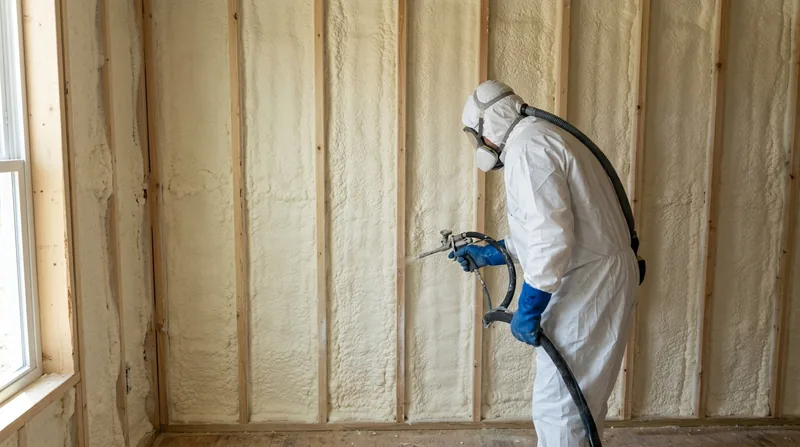




Open Cell Spray Foam Insulation in Springfield fills the stud bays and attic rafters in the newer subdivisions spreading out toward Chatham and Sherman, where two-story construction and rooms over garages create uneven heating and cooling loads that fiberglass alone cannot seal. Springfield's housing stock ranges from older downtown homes with open wall cavities to mid-century ranches with flattened attic insulation across Sangamon County, and the Midwest climate here, cold winters with ice storms, hot humid summers with severe thunderstorms, drives vapor pressure inward during summer and reverses it in winter. Open cell foam expands to fill irregular framing while staying budget friendly for retrofit work, and it works hardest in attics where hot summer peaks and cold winter valleys make settled insulation the dominant failure mode. We've been insulating Springfield homes since 2015, and we size every job to the actual R-value and thickness your attic needs, not to a price point or a salesman's quota. Call us at (217) 441-9079 for a written estimate, or read on to understand why open cell fits some homes and why closed cell spray foam is the right choice for others.
Why Open Cell Spray Foam Insulation Matters in Springfield's Newer Subdivisions
Open cell foam is softer, more flexible, and absorbs sound better than closed cell, which makes it the natural choice for attics in two-story homes and rooms over garages where noise transfer and uneven heating are the real problems. The Chatham and Sherman subdivisions pushing out from Springfield bring modern framing with regular stud spacing and roof trusses, and open cell fills those cavities completely without the rigid density that closed cell demands. It also costs less per board foot, which matters when you are insulating 1,500 square feet of attic or 800 linear feet of rim joist in a basement renovation. Springfield's hot attics in summer and cold rim joists in winter drive energy bills in most homes, and open cell handles both by stopping air leakage and blocking conductive heat transfer. The tradeoff is that open cell is more permeable to moisture, which is why it works best in attics and garages where vapor can escape, and why we never spray it in closed crawl spaces or against exterior walls in climates where moisture can get trapped.
- Open cell foam expands to fill irregular framing and gaps that fiberglass leaves exposed.
- Sound-dampening properties reduce noise transfer between floors and from outside traffic.
- Lower cost per board foot makes it practical for larger attic areas and retrofit work.
- We spray at the correct thickness and density so you get the R-value the estimate promised, not a guess.
The key is that open cell works because it seals, not because it is magic, and we verify the seal with a blower door test or a thermal image if you want proof.
Key info: Springfield's older downtown homes and Leland Grove historic neighborhoods often have open wall cavities and deteriorated attic insulation that settled over decades. Open cell retrofit fills those cavities without tearing out walls, and it works in attics because the moisture it absorbs can escape through the roof deck during dry winter months.
For more on how closed cell and open cell compare, and when each one is the right call, see our guide to closed cell spray foam insulation.
How We Install Open Cell Spray Foam Insulation in Springfield Attics and Walls
We start with a site visit to measure the attic or wall cavity, assess ventilation and any existing insulation, and check for moisture, leaks, or contamination that must be fixed before we spray. We do not spray over wet substrates, active leaks, or deteriorated wood, and we will walk away from a job if the moisture problem is not solved first. Once the space is dry and prepped, we spray open cell foam in thin, controlled passes to build to the target thickness and R-value named in your estimate, maintaining the correct drum temperature and mix ratio so the foam cures properly. Mechanical ventilation runs during cure and for a stated re-entry window of twenty-four to forty-eight hours, which prevents off-gassing complaints and lets the foam cure to full strength. We then air-seal any remaining gaps around penetrations, rim joists, or band joists with caulk or additional foam, and we provide you with a written record of what we sprayed, where, and to what thickness.
- We conduct a free on-site estimate with measurements, R-value targets, and a written scope.
- We verify that the substrate is dry and sound, and we fix moisture or leaks before spraying.
- We spray open cell in thin, controlled passes at the correct ratio and temperature.
- We run mechanical ventilation during cure and observe a twenty-four to forty-eight hour re-entry window.
- We air-seal remaining gaps with compatible caulk and document the finished work with photos and notes.
This process takes one to three days depending on the size of the attic or wall area, and it leaves no odor once the re-entry window closes.
Example: A two-story home in Sherman with an unfinished attic over the master bedroom and a bonus room had settled fiberglass and open rafter bays. We sprayed open cell to R-38 in the attic, sealed the rim joist where it met the exterior wall, and air-sealed around the ceiling penetrations. The homeowner reported noticeably quieter upstairs in summer and even heating throughout winter. Total time on site was two days.
If you have existing insulation that needs to be removed first, our insulation removal service handles that as a separate scope before we spray new foam.
Open Cell Spray Foam Insulation Methods and Best Uses
| Approach | Description | Best For |
|---|---|---|
| Attic Retrofit | Spray open cell over existing settled insulation or directly on the attic floor to R-38 or R-49. | Older Springfield homes with degraded attic insulation and hot summers; rooms over garages. |
| Sealed Rafter Bay | Spray open cell against the roof deck and into rafter cavities to create a conditioned attic. | Finished attics, bonus rooms, or homes where attic ductwork must be protected from temperature swings. |
| Wall Cavity Fill | Inject open cell into open stud bays during new construction or retrofit, filling irregular framing completely. | New subdivisions near Chatham and Sherman; older homes with open wall cavities undergoing renovation. |
| Sound Dampening | Open cell absorbs airborne sound, reducing noise between floors and from exterior sources. | Multi-story homes, rooms above garages, homes near traffic or neighbors; home theater or music rooms. |
| Rim Joist Air Seal | Spray open cell around the rim joist where the house frame meets the foundation to block cold air. | Springfield basements with cold rim joists in winter; homes with crawl spaces or unfinished basements. |
Each of these approaches is sized to your specific attic, wall, or basement condition, and we do not use open cell where closed cell is the right answer, such as in metal buildings or exposed rim joists in damp crawl spaces.
Open Cell Spray Foam Insulation Cost in Springfield: What to Expect
Open cell spray foam insulation in Springfield typically runs from $0.55 to $0.85 per board foot, depending on the size of the project, the complexity of the framing, and whether existing insulation must be removed first. A 1,500 square foot attic sprayed to R-38 or R-49 might cost $2,500 to $4,200 before any removal or air-sealing extras. Smaller jobs like rim joist sealing or a single-room retrofit start lower, around $800 to $1,500, while larger whole-house attic and wall work with removal can run $5,000 to $8,000 or more. The main factors that move the price are the total board feet of foam needed, whether you are spraying over existing insulation or a clean substrate, access to the attic or walls, and whether the space is dry and ready to spray or requires moisture remediation first. We provide a written estimate with the R-value, thickness, and square footage clearly stated, so you know exactly what you are paying for and can compare our number to other quotes. For a detailed pricing table and to understand how different project sizes stack up, visit our pricing page.
The honest advice is this: get two or three estimates from local contractors, compare the R-value and thickness they specify, not just the price, and ask each one to explain what drives their number. A suspiciously low bid usually means thin application, no ventilation during cure, or a contractor who cuts corners on drum temperature and ratio. Our estimate is free, includes a site visit, and comes with no obligation to book.
Open Cell Spray Foam Insulation Near Me: What Springfield Homeowners Should Know When Hiring
Hiring the right spray foam contractor is about more than price. You want someone fully insured, someone who shows up with a written estimate that names the R-value and thickness, and someone who explains why open cell is right for your home or why closed cell would be better. Many spray foam crews work out of out-of-state trailers, spray a job in an afternoon, and disappear when the smell lingers or the foam does not cure properly. A local contractor with a local address and local insurance is accountable, and a contractor who is willing to walk away from wet substrates or moisture problems is honest. Ask any contractor you call to verify their insurance, to provide references from jobs in Springfield or nearby, and to explain their ventilation and cure process in detail. If they promise immediate re-entry, or makes absolute safety claims, that is a red flag. The right answer is that correct installation and a stated re-entry window of twenty-four to forty-eight hours protect your home and your family. For permitting questions specific to your address in Springfield, defer to your local building department, as requirements vary by city and neighborhood. Call us at (217) 441-9079 or request a free estimate online, and we will walk you through the process step by step.
- Verify that any contractor is fully insured and can provide a current certificate of insurance.
- Get a written estimate that specifies R-value, thickness in inches, and the total board feet of foam.
- Ask the contractor to describe their ventilation setup during cure and the re-entry window they observe.
- Request references from recent jobs in Springfield, Chatham, Sherman, or nearby communities.
- Confirm that the contractor will not spray over wet, leaking, or contaminated substrates.
- Check with your local building department about any permit requirements or thermal barrier rules at your address.
A good contractor makes the process transparent and is happy to answer every question before the job starts.
Open Cell Spray Foam Insulation in Springfield: Pricing Guide
| Service | Price | Details |
|---|---|---|
| Attic Retrofit (Open Cell) | Starting at $0.55/board ft | Spray over existing settled insulation or directly on deck to R-38. Price varies with attic size and whether removal is needed first |
| Wall Cavity Fill (New or Retrofit) | Starting at $0.60/board ft | Open cell injected into stud bays. Cost depends on linear feet of wall, framing regularity, and whether cavities are accessible or require demolition |
| Rim Joist and Band Joist Sealing | Starting at $800 | Open cell sprayed around basement rim joists to block cold air and seal gaps. Price scales with linear footage of perimeter and complexity of access |
| Sealed Rafter Bay or Bonus Room | Starting at $1,200 | Spray open cell against roof deck and into rafter cavities for finished attic space. Cost depends on square footage and whether roof is ventilated or sealed |
| Removal and Re-Insulation | On estimate | When existing insulation must be removed before spraying, total cost includes removal labor, disposal, and new foam application. Requires site assessment |
| Free Estimate and Travel | No charge | Included in Springfield and surrounding areas within service territory. Response within 24 hours at (217) 441-9079 |
Indicative pricing, the exact cost depends on square footage, finish, and site access. Free personalized estimate within 24h at (217) 441-9079.


