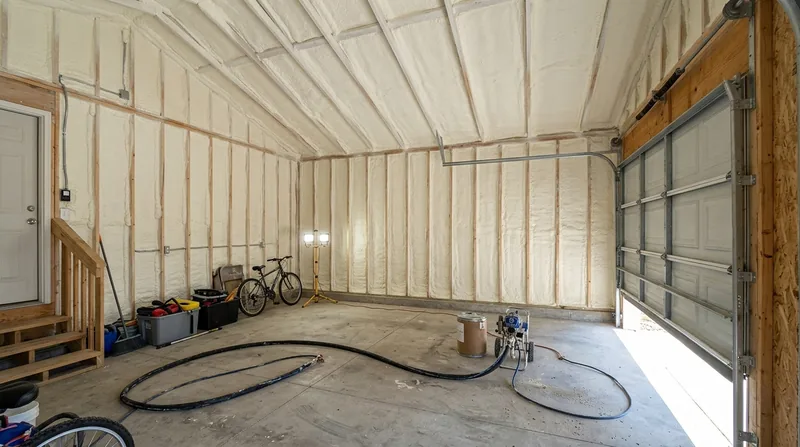




Garages across Sangamon County sit uninsulated or poorly insulated in most Springfield homes, allowing summer heat and winter cold to transfer freely into rooms above and adjacent living spaces. Whether your garage is a detached structure near downtown Springfield, a side-loaded bay in the mid-century ranches scattered through the county, or an attached space in the newer subdivisions pushing toward Chatham and Sherman, the thermal boundary between inside and outside is often missing entirely. Garage spray foam insulation seals walls and ceilings to stop that heat and cold transfer, evening out temperatures for the rooms that matter and cutting the load on your heating and cooling system. We spray closed cell or open cell foam depending on your garage use and budget, add mechanical ventilation during cure, and deliver a written estimate with R-value and thickness specifications before we start. Since 2015 we have served Springfield and the surrounding towns with insulation work that holds up through the Midwest cold-weather cycle and the seasonal vapor drive that flips between summer humidity and winter dryness.
Why Garage Insulation Matters in Springfield: Heat Loss and Cold Floors
An uninsulated garage ceiling is a direct thermal path into the living space above it. In winter, heated air rises into an uninsulated attic and bleeds through the garage ceiling, forcing your furnace to run longer. In summer, the garage heats to 110 degrees or more, and that heat radiates down into the garage itself and sideways into the living space, making your air conditioner work harder. The rim joists and band joists on the perimeter of the garage, where the walls meet the foundation, are another source of cold drafts in winter and heat gain in summer. Most Springfield homeowners do not realize the garage is the culprit until they foam it and feel the difference immediately.
- Uninsulated garage ceilings allow conditioned air from living spaces above to escape into the attic, raising heating and cooling costs year-round.
- Garage walls and ceilings radiate absorbed heat in summer and conduct cold from outside in winter, creating uncomfortable conditions in adjacent rooms.
- Rim joists and band joists along the garage perimeter are major thermal bridges that foam seals completely, unlike fiberglass batts or blown-in insulation.
- Foam also air-seals the garage, stopping air leakage around electrical outlets, light fixtures, and door frames that fiberglass cannot address.
Spray foam insulation addresses all four of these failure modes in a single application, which is why it is the standard in new construction and the preferred retrofit in homes where the garage is attached or where rooms sit directly above it.
Key info: In Springfield and the surrounding Sangamon County area, winter temperatures drop well below freezing for extended periods, and summer humidity can exceed 70 percent. A spray foam garage ceiling also acts as a vapor barrier, controlling the seasonal flip of moisture drive that occurs in the Midwest and preventing condensation on rim joists and band joists during the cold months.
For more on how spray foam controls moisture and handles the Midwest climate, see our page on closed cell spray foam insulation, which is the standard for garage applications.
How We Insulate Your Garage: From Inspection to Cure
We start with a walk-through of your garage to identify rim joists, band joists, electrical penetrations, plumbing, and any existing insulation or debris that needs removal. We assess whether the substrate is dry and sound, and if it is not, we stop and recommend the fix before we spray. Once the garage is ready, we set up mechanical ventilation to run during application and through the cure window, protecting your home and the neighborhood. We spray the walls, ceilings, and rim joists to the specified thickness, usually 1.5 to 2 inches for closed cell foam in a garage, and we install a thermal barrier if the foam is exposed to the living space (a requirement under the energy and building code in Springfield).
- We inspect the garage for moisture, existing insulation, and structural soundness before scheduling a spray date.
- We set up mechanical ventilation and run it continuously during application and for 24 to 48 hours after spraying is complete.
- We spray closed cell or open cell foam to the thickness and R-value specified in your estimate, covering walls, ceilings, and rim joists.
- We install a thermal barrier (typically latex-based paint or gypsum board) over any foam exposed to the living space, as required by code.
- We provide a written record of the work, including the foam type, thickness, and the re-entry window for your household.
The job typically takes one to two days for a single-car or two-car garage, depending on the size and the amount of prep work required.
Example: A two-car garage in Sherman with 500 square feet of ceiling and wall area, uninsulated rim joists, and sound substrate takes about one day to spray with closed cell foam at 1.5 inches, plus 24 hours for cure. The homeowner closes the garage door, we run the ventilation fan out a window, and the family stays in the house. The garage is ready to use the next morning.
If your garage requires removal of old insulation before we spray, we handle that as a separate scope and charge accordingly.
Spray Foam Methods for Garage Insulation
| Approach | Description | Best for |
|---|---|---|
| Closed Cell Foam | High-density foam sprayed at 1.5 to 2 inches, R-value 6 to 6.5 per inch, creates a vapor barrier and air seal in one pass. | Garage ceilings, rim joists, and band joists where vapor control and maximum R-value per inch are priorities. |
| Open Cell Foam | Lower-density foam sprayed at 5 to 6 inches, R-value 3.5 to 3.8 per inch, allows vapor transmission and is less expensive per board foot. | Garage walls where budget is tight and the wall assembly can manage moisture without a vapor barrier on the inside. |
| Rim and Band Joist Only | Closed cell foam applied to the perimeter of the garage where it meets the foundation, typically 1 to 1.5 inches, without insulating the full ceiling. | Detached garages or shops where the ceiling is not a thermal boundary to living space but cold floors and drafts are a problem. |
| Partial Ceiling with Rim Joist | Closed cell foam on rim and band joists plus insulation of the ceiling above attached living spaces, leaving the rest of the ceiling uninsulated. | Attached garages in older Springfield homes where the upper rooms matter but budget limits a full garage insulation job. |
Garage Spray Foam Insulation Cost in Springfield: What to Expect
Garage spray foam insulation in Springfield starts at approximately $1,200 for a single-car garage with a ceiling and rim joists, using closed cell foam at 1.5 inches. A two-car garage typically runs $2,000 to $3,500 depending on the size of the space, the condition of the substrate, and whether rim joists and band joists are included. Open cell foam is less expensive per board foot, so a full garage with open cell might run 20 to 30 percent lower, though the thicker application required to reach equivalent R-value can offset some of that savings. If the garage requires insulation removal first, add $200 to $600 depending on the volume and type of existing material.
The main factors that move the price are the square footage of walls and ceiling, the thickness and type of foam, the condition of the substrate (whether it is clean and dry), and the amount of prep work. A garage with old fiberglass batts, dust, and debris costs more to prepare than a clean, empty garage. Travel is included in our service area across Springfield and the surrounding towns, so there is no separate mileage fee. Get a free written estimate with R-value and thickness specified before you commit, and compare two or three quotes to understand what is standard in your market.
Real example: A 400-square-foot attached garage in Leland Grove with a finished bedroom above and uninsulated rim joists, sprayed with closed cell foam at 1.5 inches on the ceiling and 2 inches on the rim joists, came to $2,400 including removal of old blown-in insulation and a latex thermal barrier over the foam. The homeowner noticed warmer floors in the bedroom within a week and lower heating bills the following winter.
For a detailed breakdown of pricing across all our services, visit our pricing page.
Garage Spray Foam Insulation Near Me: What Springfield Homeowners Should Know When Hiring
When you are looking for a spray foam insulation contractor in Springfield or the surrounding Sangamon County area, start by asking whether the contractor is fully insured and can provide a certificate of insurance on request. Do not accept a verbal assurance or a price quote without a written scope of work that includes the foam type, R-value, and thickness. Many homeowners are surprised by the cost of spray foam because they compare it to blown-in fiberglass without understanding that foam is a vapor barrier and an air seal, not just insulation. A reputable contractor will explain the difference and recommend the right product for your garage use and climate, even if it means a lower price than the alternative.
- Ask for a written estimate that specifies the foam type (closed or open cell), the R-value per inch, and the thickness in inches on each surface (ceiling, walls, rim joists).
- Verify that the contractor runs mechanical ventilation during application and cure, and ask for the re-entry window in writing.
- Request references from recent garage insulation jobs in Springfield or nearby towns, and call at least two.
- Confirm that the contractor is fully insured and will provide proof of coverage before work begins.
- Ask whether permits are required for your address and who is responsible for pulling them (permitting rules vary by city in Sangamon County).
If your garage is part of an HOA or a master-planned community, check whether architectural approval is required for exterior work. Most insulation work is interior, so HOA rules rarely apply, but it is worth confirming. Contact us at (217) 441-9079 for a free, no-obligation estimate and we will walk you through the process and answer your questions.
Garage Spray Foam Insulation in Springfield: Pricing Guide
| Service | Price | Details |
|---|---|---|
| Single-car garage ceiling and rim joists | Starting at $1,200 | Closed cell foam at 1.5 inches on ceiling, 2 inches on rim joists, includes ventilation and thermal barrier |
| Two-car garage with full insulation | Starting at $2,000 | Closed cell foam on ceiling, walls, and rim joists at 1.5 to 2 inches, includes prep, ventilation, and thermal barrier |
| Open cell foam garage (full) | Starting at $1,500 | Lower density open cell at 5 to 6 inches, less expensive per board foot than closed cell, suitable for budget-conscious retrofits |
| Insulation removal and replacement | Add $200 to $600 | Cost depends on volume and type of existing insulation; old fiberglass batts, blown-in cellulose, or debris removal |
| Travel | Included | No separate mileage fee within Springfield and surrounding service areas across Sangamon County |
| Free written estimate | No charge | Response within 24 hours at (217) 441-9079, includes R-value, thickness, and foam type specifications |
Indicative pricing, the exact cost depends on square footage, finish, and site access. Free personalized estimate within 24h at (217) 441-9079.


