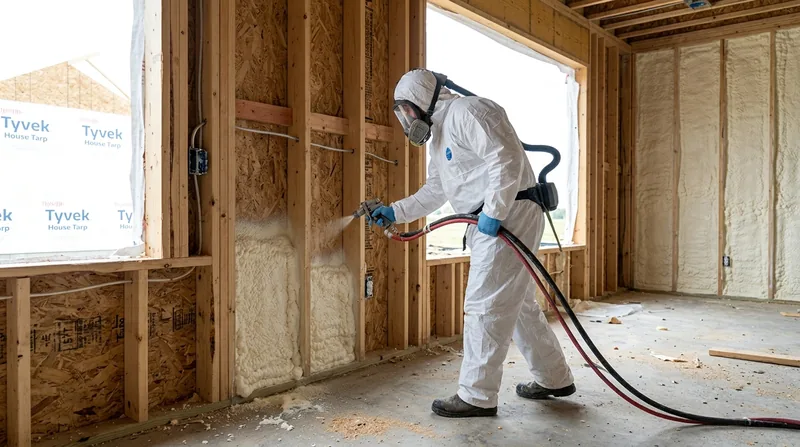




Commercial and new construction spray foam insulation in Springfield requires planning before drywall closes the walls. Builders working subdivisions near Chatham and commercial projects throughout Sangamon County need foam installed during the frame-and-rough stage, when wall cavities and rim joists are still open and accessible. Springfield's climate brings cold winters with ice storms and hot, humid summers with severe thunderstorms, which means vapor drive flips with the seasons and demands that new construction assemblies be designed correctly from the start. Older subdivisions and newer builds alike sit on basements or shallow crawl spaces where rim joists and band joists stay cold all winter and often turn damp after spring thaw or heavy rain. We work with builders and contractors to specify the right foam type, thickness, and air sealing strategy before the project closes, so energy performance and moisture control are built in from day one.
Why Commercial and New Construction Spray Foam Matters in Springfield
New construction and commercial projects in Sangamon County are built to a code that requires insulation, but code is a floor, not a ceiling. A standard fiberglass or blown-in cavity fill leaves thermal bridging through studs, rim joists, and band joists, and it does not stop air leakage at penetrations, headers, and transitions. Spray foam fills the cavity completely, blocks thermal bridges, and seals air leaks in a single pass. In Springfield, where hot attics in summer and cold basements in winter drive energy bills, that difference shows up in the first utility bill and compounds over the life of the building.
- Closed cell foam on rim joists and band joists stops moisture vapor from entering the basement or crawl space during humid summers and provides structural bracing on the rim.
- Open cell foam in walls and attics is less expensive and offers good thermal and acoustic performance when vapor drive is managed by exterior sheathing and interior drywall.
- Spray foam installed before drywall allows the builder to see every surface sprayed and verify thickness and coverage before the wall is closed.
- Air sealing around electrical boxes, rim joist transitions, and band joist to rim connections stops the leakage paths that blown-in insulation cannot reach.
- Sealed attics with spray foam on the roof deck eliminate the need for soffit venting and allow HVAC ducts and equipment to be placed in conditioned space.
Getting the insulation and air sealing right on new construction is cheaper and easier than retrofitting it later, and it is the single biggest driver of energy performance and occupant comfort in the finished building.
Key info: Illinois Building Code requires insulation rated to the climate zone and a thermal barrier or ignition barrier on foam, depending on the use class and the material. The fifteen-minute thermal barrier rule is the most commonly misapplied part of the code. Always defer to the local building official at your city or county permit office to confirm what applies at your address. Springfield, Chatham, Sherman, and other municipalities in Sangamon County each have their own building department and inspector, and the code interpretation can vary by jurisdiction.
For a detailed explanation of code requirements and how they apply to your project, contact the Illinois Emergency Management and Homeland Security Agency or your local building department.
How We Work with Builders on New Construction and Commercial Projects in Springfield
Our process starts with a site visit during the frame stage, before insulation is scheduled. We review the plans, confirm the insulation specification, check for any moisture or substrate issues, and plan the spray sequence so the foam is applied when the frame is ready and the weather is suitable. Springfield's spring and fall are ideal for new construction spray foam, when temperatures and humidity are moderate and the work can be completed without weather delays. We coordinate with the general contractor and the trade schedule, so foam is sprayed between rough electrical and plumbing and before drywall delivery.
- We visit the site during the frame stage and review the plans, building code requirements, and the insulation specification.
- We identify all areas to be foamed: exterior walls, rim and band joists, basement walls, crawl space headers, attic or roof deck, and any special assemblies.
- We confirm substrate condition, check for moisture or active leaks, and halt the work if the substrate is wet or contaminated.
- We schedule the spray when the frame is complete, the weather window is open, and the trade sequence allows mechanical ventilation during cure.
- We spray the foam to the specified thickness and R-value, verify coverage with a thickness gauge, and provide the builder with a certificate showing board feet installed and R-value achieved.
- We allow the manufacturer's recommended cure time (typically 24 to 48 hours) before the next trade moves in.
This sequence ensures the foam is installed correctly, the builder has a record of what was done, and the project stays on schedule.
Example: A new 40-unit townhome subdivision near Chatham specified closed cell foam on rim and band joists (R-20 at 3.5 inches) and open cell foam in the exterior walls (R-15 at 5.5 inches). We sprayed the rim joists in the first week of May, when the concrete was cured and the framing was complete. The walls were sprayed two weeks later, after rough electrical was done. The builder received a certificate showing 1,200 board feet of closed cell and 2,100 board feet of open cell, and drywall was hung on schedule.
Spray Foam Methods for Commercial and New Construction
The choice between closed cell and open cell foam depends on the assembly, the climate, and the performance goal. Both are installed by hand-held spray gun and require trained application technicians, proper ratio control, and adequate ventilation during cure. The table below outlines the key differences and best uses for each.
| Foam Type | Description | Best For |
|---|---|---|
| Closed Cell | High-density foam (1.5 to 2 lbs/cubic foot) with a closed-cell structure that resists moisture and air infiltration. R-value is 6 to 6.5 per inch. | Rim joists, band joists, basement walls, crawl spaces, metal buildings, and any assembly where moisture control and structural bracing are priorities. |
| Open Cell | Low-density foam (0.5 to 1 lbs/cubic foot) with an open-cell structure that allows moisture vapor to pass through. R-value is 3.5 to 4 per inch. | Exterior walls, attics, and roof decks in new construction where vapor management is handled by exterior sheathing and interior drywall. |
| Hybrid (2-Part) | Closed cell on rim and band, open cell in walls. Balances moisture control on cold surfaces with cost and acoustic performance in the wall cavity. | Mixed-use buildings and multi-family projects where different zones have different moisture and thermal demands. |
| Removal and Re-Spray | We remove failed or mis-applied foam, verify substrate condition, and re-spray to specification. Includes disposal and air quality testing if required. | Projects where prior foam installation failed to meet code, was applied over wet substrate, or did not achieve the specified R-value. |
Each method has a specific use case. Closed cell is the right choice for moisture control and structural bracing. Open cell is the right choice for cost and acoustic performance when vapor drive is managed by the assembly design. We specify based on the building use, the climate, and the code requirements at your address. For details on how we choose the right foam type and thickness for your project, see our closed cell foam page or open cell foam page.
Commercial and New Construction Spray Foam Cost in Springfield: What to Expect
The cost of spray foam on a new construction or commercial project depends on the square footage of walls and rim joists to be insulated, the type of foam specified, the access to the work area, and the site conditions. A free commercial estimate is the only honest way to price a spray foam job, because every project is different. We visit the site, measure the areas to be foamed, confirm the specification, and provide a detailed quote showing the board feet of foam, the R-value achieved, and the labor and material cost.
For a typical new construction project in Springfield or Chatham with 20,000 to 30,000 square feet of exterior wall and rim joist to be insulated, expect closed cell foam on rim joists to run $1.50 to $2.50 per board foot installed, and open cell foam in walls to run $0.60 to $1.00 per board foot. A hybrid approach (closed cell rim, open cell walls) is common and balances performance and cost. Larger commercial projects and metal buildings may see lower per-board-foot rates due to volume and access. Small residential retrofits or spot repairs cost more per board foot because the setup and travel time is fixed.
Always get 2 to 3 estimates from contractors who provide a written quote with R-value, thickness, and board feet specified. Avoid any estimate with no R-value or thickness stated, no site visit, or a price far below market. The cheapest estimate is often the fastest to fail. See our pricing page for more detail on what drives cost, or call us for a free commercial estimate at (217) 441-9079.
What to Look for When Hiring a Spray Foam Insulation Contractor Near Springfield
Hiring the right spray foam contractor is critical because the work is hidden once drywall is hung, and a poor installation cannot be easily fixed without tearing apart the assembly. The insulation trade has two extremes: rig-and-run crews in unmarked trailers with no local address and no accountability, and national franchises with high overhead and standardized pricing. The local independent shop is positioned between them, with skin in the game and a reputation to protect. Here is what to check when evaluating any contractor, including us.
- Verify the contractor is fully insured and ask for a certificate of insurance naming your project and your general contractor as additional insureds.
- Ask for a written estimate with the foam type, thickness in inches, R-value per inch, total board feet, and the labor and material cost itemized separately.
- Request references from recent commercial or new construction projects in Springfield, Chatham, or nearby, and call at least two to ask about the quality of the spray, the cure time, and any issues after the job.
- Confirm that the contractor has read the local building code and understands the thermal barrier and ignition barrier requirements at your address, and that the estimate reflects any special requirements.
- Ask about the spray crew's training and experience with the foam system being used, and whether the contractor is affiliated with the foam manufacturer or uses a third-party applicator.
- Check that the contractor plans to use mechanical ventilation during cure and will provide a re-entry window of 24 to 48 hours before the next trade moves in.
- If your project is in an HOA or master-planned community, confirm that the contractor understands any architectural rules that may apply to exterior work or material choices.
A contractor who answers these questions clearly and without hesitation is likely to do the job right. A contractor who gives vague answers, promises immediate re-entry, or has no references is a risk. Contact us to discuss your project and get a free estimate. We have been in business since 2015, and we are happy to answer any questions about our process, our crew, and our track record on commercial and new construction projects in Sangamon County.
Commercial & New Construction Spray Foam in Springfield: Pricing Guide
| Service | Price | Details |
|---|---|---|
| Free commercial estimate | Free | Site visit, measurement, specification review, written quote with board feet and R-value, no obligation |
| Closed cell foam on rim and band joists | Starting at $1.50 per board foot | Installed, includes labor, material, and thickness verification; cost varies by access, site conditions, and project size |
| Open cell foam in exterior walls | Starting at $0.60 per board foot | Installed, includes labor and material; price depends on wall height, linear feet, and whether foam is applied to one or both sides |
| Hybrid approach (closed cell rim and band, open cell walls) | On estimate | Combination pricing reflects the cost of both foam types; total cost depends on the ratio of closed to open cell square footage |
| Travel and mobilization | Included | No separate mileage fee for projects in Springfield and surrounding Sangamon County service areas |
Indicative pricing, the exact cost depends on square footage, finish, and site access. Free personalized estimate within 24h at (217) 441-9079.


