Why Leland Grove Historic Homes Need Smart Insulation Choices
Leland Grove is one of Springfield's most charming neighborhoods, known for its beautifully preserved historic homes and tree-lined streets. If you own one of these architectural gems, you understand the balance between maintaining historical integrity and upgrading systems for modern comfort and efficiency. Your attic insulation plays a critical role in that equation, yet many homeowners don't realize how their insulation choice impacts both their home's performance and its character.
The challenge facing Leland Grove residents is straightforward: historic homes often have outdated or inadequate insulation that fails to meet today's energy standards. Whether your attic currently has old fiberglass batts, cellulose, or nothing at all, you're likely losing conditioned air and paying higher heating and cooling bills. The good news is that modern insulation technology offers several paths forward, each with distinct advantages and trade-offs. Understanding these options helps you make an informed decision that protects your home's value, comfort, and efficiency.
Spray Foam vs Blown-In Insulation: Performance and Application
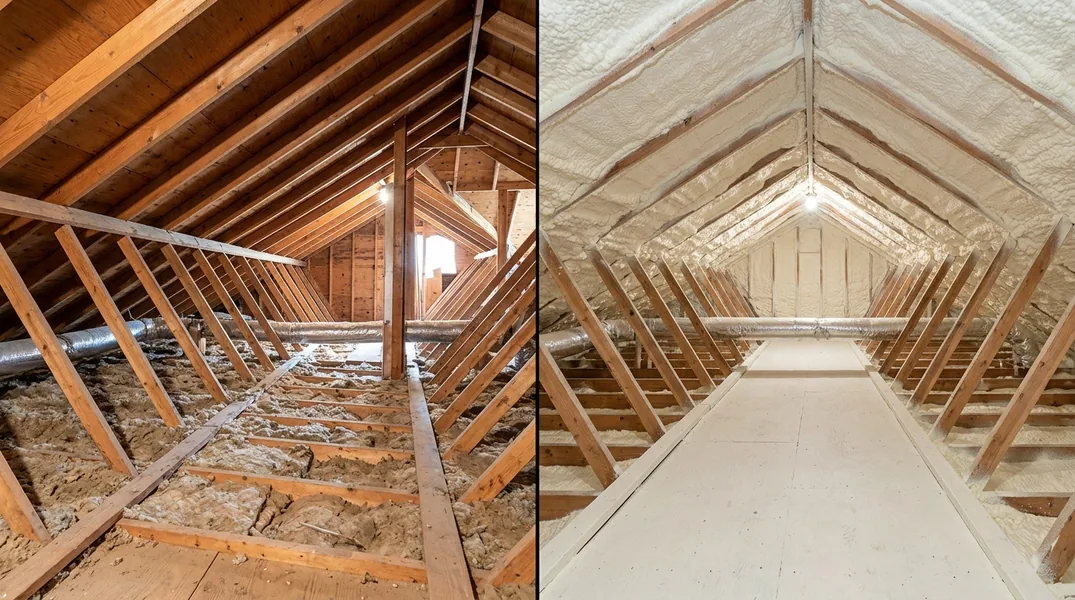
Attic Spray Foam Insulation and blown-in insulation represent two fundamentally different approaches to attic coverage. Blown-in insulation, typically made from cellulose, fiberglass, or mineral wool, is installed by blowing loose material into attic cavities using specialized equipment. It settles to create a blanket of insulation across joists and rafters. Spray foam, by contrast, is applied as a liquid that expands and hardens in place, creating a sealed, continuous barrier that adheres to all surfaces it contacts.
The performance difference stems from how each material handles air leakage. Blown-in insulation provides solid R-value per inch but does nothing to seal air leaks around wiring, ductwork, or structural penetrations. Spray foam simultaneously insulates and air seals, filling gaps and crevices that would otherwise allow conditioned air to escape. For homeowners in Springfield dealing with older homes that tend to have more irregular framing and hidden gaps, this air-sealing capability represents a significant performance advantage. You'll notice the difference in winter drafts and summer cooling costs.
Spray Foam vs Fiberglass: Which Insulation Wins for Attics
Fiberglass batts have been the standard attic insulation for decades, and they remain popular because they're affordable and easy to install. However, fiberglass has several inherent limitations that make spray foam a superior choice for many homeowners. Fiberglass batts are only effective when installed perfectly, with no gaps between pieces and proper coverage around obstacles. In real-world applications, especially in older homes with uneven framing, this rarely happens. Gaps around rafters, beams, and penetrations create thermal bridging and air leakage paths that reduce the effective R-value significantly.
Spray foam eliminates these installation variables entirely. Because it expands to fill every void and adheres to all surfaces, you get consistent performance throughout your attic, regardless of framing irregularities or complexity. Fiberglass also absorbs moisture, which can lead to mold growth and degradation over time, particularly in humid climates or poorly ventilated attics. Spray foam resists moisture absorption, especially Closed Cell Spray Foam Insulation, which creates a vapor barrier as part of its installation. For homeowners seeking the best insulation for attic performance and longevity, spray foam consistently outperforms traditional fiberglass.
Spray Foam vs Cellulose: Durability and Long-Term Value
Cellulose is an eco-friendly blown-in insulation made from recycled paper products, and it appeals to environmentally conscious homeowners. It offers decent R-value per inch and costs less than spray foam. However, cellulose shares the same fundamental weaknesses as fiberglass when it comes to air sealing and long-term durability. Cellulose is hygroscopic, meaning it readily absorbs moisture from the air. In attics with inadequate ventilation or high humidity, cellulose can absorb significant moisture, leading to settling, compression, and mold growth. Once cellulose settles, your R-value drops because the material is no longer uniformly dense.
Spray foam doesn't settle, compress, or degrade over time in the way cellulose does. It maintains its R-value and air-sealing properties for the life of your home. While cellulose may have a lower upfront cost, the long-term performance and durability of spray foam often deliver better value, especially when you factor in energy savings and the absence of future replacement costs. For historic Leland Grove homes that you plan to occupy for decades, spray foam represents a one-time investment that keeps working year after year without maintenance or replacement.
Attic Spray Foam Insulation Cost in Springfield: What to Budget
Cost is a legitimate consideration when choosing insulation, and it's important to understand what drives pricing for spray foam installation. The cost of Attic Spray Foam Insulation depends on several factors: the square footage of your attic, the R-value you're targeting, whether you choose open-cell or closed-cell foam, and the complexity of your attic's layout. Open-cell spray foam typically costs less per board foot than closed-cell but offers lower R-value per inch. Closed-cell provides superior R-value, better moisture resistance, and added structural rigidity, but commands a higher price.
When comparing costs, avoid looking at price per square foot in isolation. Instead, consider the total value proposition: energy savings, durability, air sealing, and elimination of future replacement costs. Many homeowners find that spray foam pays for itself within five to ten years through reduced heating and cooling bills, especially in older homes where energy waste is significant. To understand the true cost and value for your specific attic, reach out to Springfield Spray Foam Insulation at (217) 441-9079 for a free estimate. Our team can assess your attic, discuss your goals, and provide transparent pricing that accounts for your home's unique characteristics.
Making the Right Choice for Your Historic Home
Choosing the best insulation for your Leland Grove attic ultimately comes down to balancing performance, durability, and value. Spray foam outperforms blown-in insulation and fiberglass in air sealing, resists moisture better than cellulose, and maintains its R-value indefinitely. For homeowners committed to long-term comfort and efficiency, spray foam is the clear winner. That said, the right choice for your home depends on your specific situation: your budget, your attic's condition, your energy goals, and your timeline.
The experts at Springfield Spray Foam Insulation understand the unique needs of historic homes in our area. We've helped countless homeowners in Springfield and surrounding communities upgrade their attics while respecting their homes' character and integrity. Whether you're deciding between spray foam and other options, or you're ready to move forward with installation, we're here to guide you. Contact us today at (217) 441-9079 or visit our website to schedule your free estimate. Let's make sure your historic home stays comfortable, efficient, and protected for generations to come.
Looking for a professional spray foam insulation contractor in Springfield? Springfield Spray Foam Insulation responds fast for all your spray foam insulation needs.
Get a Free Quote